
Pike Road tree problems
Pine Tree Turning Brown in Pike Road, Alabama
A pine in Pike Road whose needles turn yellow and then rusty red over a few weeks is most often being killed by bark beetles, and Alabama Extension says the blue stain fungus that Ips engraver beetles and southern pine beetles carry can kill a tree in one to two weeks, often before the beetles finish girdling it (Managing Pine Bark Beetles in Urban Forests, FOR-2049, checked Nov 22, 2026). Extension's advice for a yard pine with an active Ips or southern pine beetle attack is to remove it promptly and grind the stump, and to keep an eye on the pines within about 20 yards of it.
Which beetles kill pines around Pike Road?
Alabama Extension names three bark beetles threatening the state's pines: the southern pine beetle, the black turpentine beetle and Ips engraver beetles (Bark Beetles Threatening Alabama's Forests, FOR-2200, April 2026, checked Nov 22, 2026). They don't behave the same:
| Beetle | What the tree shows | How dangerous |
|---|---|---|
| Ips engravers | Attacks on the mid to upper trunk and branches, and on slash; sudden, often patchy needle color change; fine reddish-brown boring dust; small, few pitch tubes; H-, Y- or I-shaped galleries under the bark | Its blue stain fungus can kill a pine in one to two weeks |
| Southern pine beetle | Gradual fading of the crown; dime-sized pitch tubes; S-shaped galleries | Same fungus; can kill large areas in an outbreak |
| Black turpentine beetle | Larger pitch tubes | Less aggressive; usually doesn't kill healthy pines, and infested trees can sometimes be treated |
The Alabama Forestry Commission adds that the first sign of a southern pine beetle attack is usually "yellowing or browning of needles," that in drought the pitch tubes may be tiny or missing and only reddish-brown boring dust shows, and that one attack cycle takes 25 to 40 days depending on temperature (Alabama Forestry Commission, checked Nov 22, 2026). It puts the state's average loss in a southern pine beetle outbreak at 60,000 pine trees a year.
How can you tell from the yard?
Walk around the trunk and look closely at the bark.
- Pitch tubes: popcorn-like blobs of resin on the bark plates, white, yellow or reddish. Extension says Ips and southern pine beetle tubes are about the size of a dime; black turpentine beetle tubes are larger.
- Boring dust: reddish sawdust in the bark crevices or piled at the base of the tree. In dry weather it may be the only sign.
- Color: needles going yellow, then rusty red. A pine that turns all at once points toward Ips.
- Under loose bark: the gallery shape tells the beetles apart, H, Y or I for Ips and S for southern pine beetle.
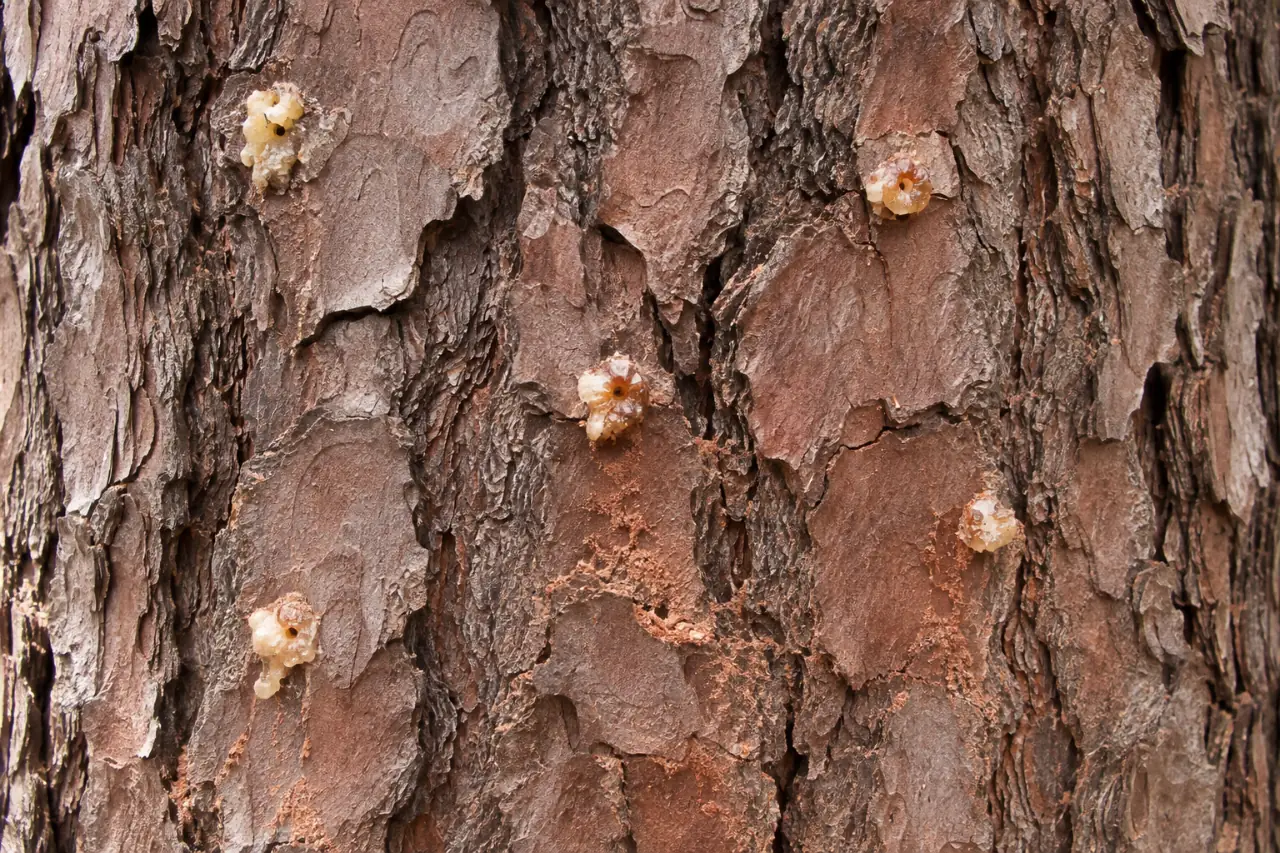
The worry is a crown that changes color from the top or all over, with pitch tubes or boring dust on the bark to go with it.
Why do yard pines get hit?
Bark beetles go after pines that are already under stress. Extension lists drought, lightning strikes, root damage from construction, trunk wounds, storm damage and overcrowding as triggers (FOR-2049, checked Nov 22, 2026). Construction is one of them, so pines near a new house, pool or driveway are worth watching for a few years.
Extension's advice for protecting pines during construction: don't cut roots or pile soil over them inside the drip line, keep equipment from scraping the trunk or roots, and don't park inside the drip line, because compacted soil stresses the tree.
What should you do with a pine that's under attack?
- Act quickly on fresh attacks. Extension says trees with active Ips or southern pine beetle infestations should be removed promptly and the stump ground. Dead trees the beetles have already left may need no action for the beetles' sake, but they're still dead trees.
- Get the wood away from the other pines. FOR-2200 says to quickly cut, chip or debark infested trees, and to clear out slash and logging debris, which Ips can breed in.
- Look at the neighbors. Pines within about 20 yards of an infested tree are at the greatest risk, according to FOR-2049, and Extension suggests considering preventive chemical treatment for them.
- Don't prune healthy pines in spring or summer. Extension's pruning publication says pines should be pruned in winter, because spring and summer pruning makes them more prone to insect problems (ANR-0258, checked Nov 22, 2026).
Beetles or not, a dead pine beside the house is coming down one way or another. Wood dried out by beetles breaks unpredictably, which also makes the tree harder and riskier to climb. The sooner it comes down, the more options the crew has. See tree removal.
How do storms and beetles feed each other?
Storm damage is on Extension's list of triggers, and broken or downed pines left lying are breeding material. FOR-2200 tells landowners to salvage storm-damaged wood promptly. Around Pike Road that matters: the Weather Service's survey of the Dec. 29, 2024 Mt. Zion Road tornado in Montgomery County found a pine fallen into a double-wide mobile home among the damage (NWS Birmingham), and the storm record lists more.
What does removing a dead pine cost?
HomeGuide's national figures put pine removal at $200–$1,600, rising to $2,000–$3,000 once a pine passes 100 feet; if a brittle dead pine over a roof calls for a crane, each crane day runs $500–$2,500 more (HomeGuide, checked Nov 22, 2026). The price guide has Montgomery-area averages.
Pine questions people ask
Can a brown pine be sprayed and saved?
Extension's spray suggestion is preventive, for the green pines near an infested tree. For the infested tree itself, its advice is prompt removal.
Can I keep the wood for firewood?
Extension's guidance is to get infested wood cut, chipped or debarked quickly. Stacking fresh beetle-infested logs next to healthy pines works against that.
Should I replant pines?
Alabama Extension's Montgomery-area soils guide says pines grow on the better-drained sites among the area's acid clay soils, but that white oaks, red oaks, pecans and other deciduous trees make better landscape trees there (ANR-0966, checked Nov 22, 2026). The yard trees page has more.