
Pike Road job guide
Tree Removal in Pike Road, Alabama
Tree removal in Pike Road comes down to one of three methods: felling the whole tree where there's open ground to drop it, taking it apart in sections on ropes or from a lift when a house, fence or barn is in the way, or bringing a crane for a big tree that can't be climbed safely. For the Montgomery area, LawnStarter lists an average of $780 for a tree removal (page dated November 2026), and Angi lists $993 on average for removal and trimming jobs, with most between $457 and $1,484 (LawnStarter; Angi; both checked Nov 22, 2026).
Which method fits, and where in that range a tree lands, depends on its height, its health and what it would hit. One independent local contractor sees the tree in person and prices it.
Can the tree be dropped in one piece?
Sometimes, mostly on bigger lots. On a lot with pasture, a long front yard or open woods beside the house, a sound tree can be felled whole if the ground in the direction of the fall is clear for at least the tree's full height, plus room for the crown to break apart and the trunk to bounce or roll.
Felling is the fastest way to take a tree down, which usually makes it the cheapest. The cutter makes a notch on the side facing the drop zone and a back cut that leaves a strip of hinge wood to steer the fall. What rules it out:
- A lean toward the house, a shop, a fence line or the road.
- Limbs tangled with a neighbor's tree, or a power line inside the fall zone.
- Rot, a split or a hollow at the base, which can make the hinge fail and the tree go the wrong way.
- A dead pine. Wood dried out by beetles or drought can snap partway through the cut.
When does a crew take a tree down in sections?
When there's no safe place to drop the whole thing, which describes most trees within a tree-length of a house. A climber tied into the tree, or an operator in a bucket truck, removes limbs and then the trunk in pieces. Anything too heavy or too close to the house to drop gets a rope tied around it; the rope runs up through a block or friction device anchored higher in the tree and back down to a groundworker, who lets the piece down under control.
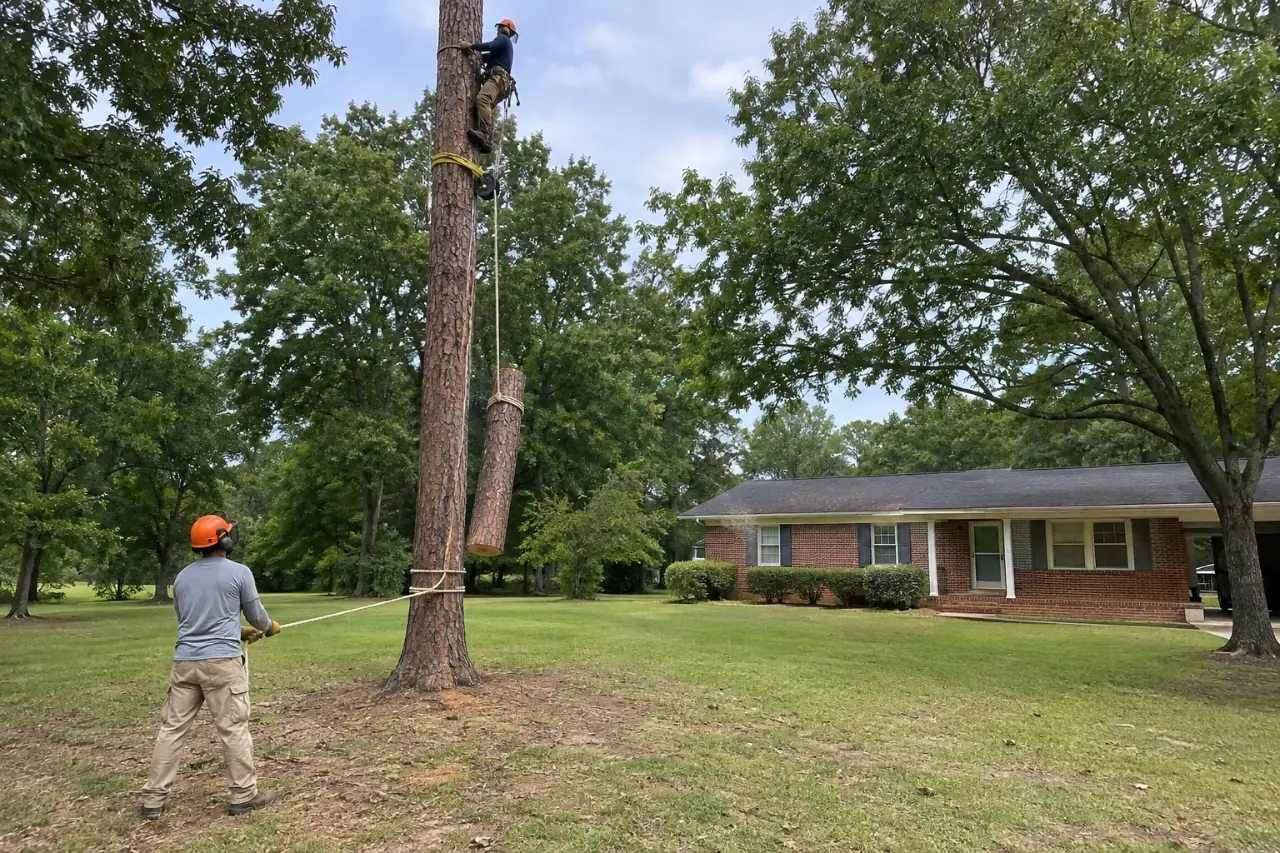
Sectional removal takes longer and needs more people than felling, which is the main reason a removal beside a house costs more than the same tree in a pasture. HomeGuide's national figures show the jump by height: $150–$500 below 30 feet, $300–$1,000 between 30 and 60, $650–$2,000 between 60 and 80, and $1,200–$2,700 above 80 (HomeGuide, checked Nov 22, 2026).
A bucket truck is quicker than climbing when it can reach the tree. Getting it there is the catch on a Pike Road lot after rain. Alabama Extension describes the clayey Black Belt soils in the Montgomery area as slow to take in water, swelling when wet (ANR-0966, checked Nov 22, 2026), and a heavy truck on soaked clay leaves ruts. Ask whether the crew will lay mats or wait for the yard to dry.
When does a crane make sense?
A crane lifts sections off the tree and sets them on the ground or a truck, so nobody has to climb a tree that isn't safe to climb, and nothing gets lowered toward a roof. It's the usual answer for a very large oak or pecan leaning over a house, or a dead pine too brittle to tie into. HomeGuide says a crane adds $500–$2,500 for each day it's on site, over and above the removal (HomeGuide, checked Nov 22, 2026).
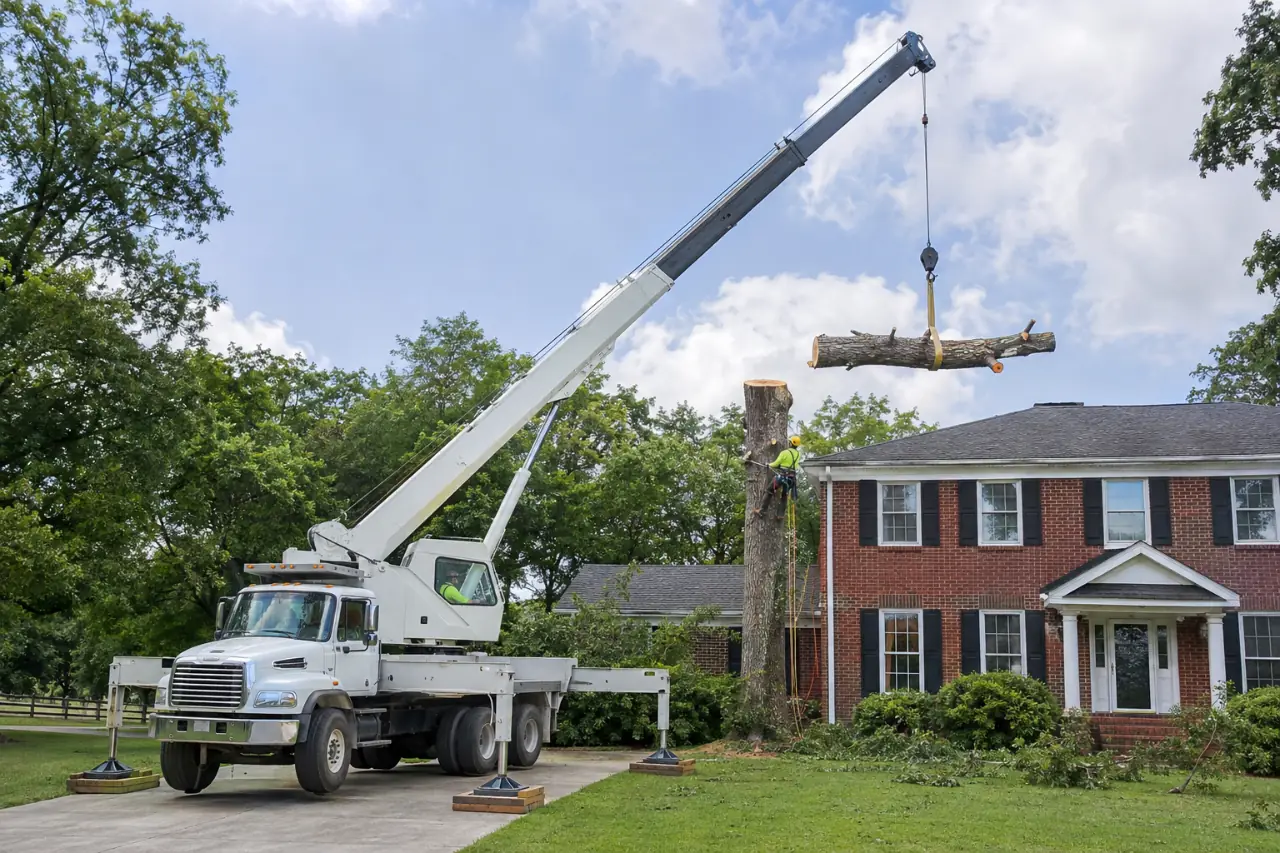
The crane needs firm, level ground for its outriggers within reach of the tree. On a long gravel drive or a soft lawn, where it can set up decides whether it can be used at all.
Why does a dead pine change the plan?
Pines killed by bark beetles don't stay standing safely for long. Alabama Extension says the blue stain fungus that Ips and southern pine beetles carry can kill a tree in one to two weeks, and it recommends removing trees with an active Ips or southern pine beetle infestation promptly and grinding the stump, while a dead tree the beetles have since abandoned may not need anything done on their account (FOR-2049, checked Nov 22, 2026). A dead pine standing over a house is still a falling hazard, beetles or not.
For the crew, a dead pine is less predictable to climb and to fell. Expect the contractor to ask how long it's been brown, and to consider a lift or a crane instead of a climber. The pine page covers how to tell an attack from ordinary needle drop.
Does the Town of Pike Road have to approve a removal?
Not for a typical tree on a lot that already has a house on it. Pike Road's tree protection and replacement section applies to residential subdivisions creating three or more lots, new multi-family developments and non-residential developments (Ordinance 2017-0363, Sec. 707.01.B, checked Nov 22, 2026). The tree rules page covers the cases that do need a call to the Town, including clearing more than 500 square feet down to bare ground and newer lots under a tree replacement plan.
What if the tree is on the property line?
Talk to the neighbor first and get the agreement in writing. Alabama law sets a penalty for anyone who cuts down or destroys trees "on land not his own, wilfully and knowingly, without the consent of the owner of the land": $20 for every cypress, pecan, oak, pine, cedar, poplar, walnut, hickory or wild cherry tree or sapling, and $10 for any other tree (Ala. Code § 35-14-1, checked Nov 22, 2026). If a survey stake or fence doesn't settle where the line runs, settle that before the saw starts.
Where does the wood go afterward?
Ask for it in writing. The usual choices are:
- Everything hauled away: brush chipped into the truck and logs loaded out. The most hauling, so usually the highest price.
- Wood left in rounds: trunk cut into firewood-length rounds and stacked where you choose; brush chipped and hauled.
- Chips left: chips dumped in a pile for mulch.
- Logs left whole: common on large lots, where the logs can go to the edge of the woods.
Pike Road's garbage contractor, AmWaste, provides weekly garbage collection and yard waste pickup (Town of Pike Road utility services, checked Nov 22, 2026), but the Town's page doesn't say how much it takes or whether it picks up a whole tree's worth of contractor-cut wood. Plan on the contractor handling the wood unless AmWaste (334-625-1700, per the Town FAQ, checked Nov 22, 2026) says otherwise.
What goes wrong on removal jobs?
- Hidden decay. A trunk that looks solid can be hollow at the base. Alabama Extension points to the root crown and the middle of the trunk as the places to look for decay, cavities and structural flaws (Alabama Extension, checked Nov 22, 2026).
- Lines nobody planned for. The service drop to the house often runs under or through limbs. Alabama law keeps people and equipment 10 feet from lines over 750 volts unless the line is made safe first (Ala. Code § 37-8-52, checked Nov 22, 2026). See the power line page.
- Ruts and broken drives. Wet clay, septic lines and thin concrete don't hold heavy trucks well. Point out the septic tank and field lines before work starts.
- The stump wasn't in the price. Removal and stump grinding are often priced separately. Check which one you're agreeing to.
When is removal the wrong answer?
When the problem is one limb, not the whole tree. Alabama Extension's post-storm guide says a hardwood whose trunk breaks in the top third can be pruned and watched, with a moderate chance of survival, while a pine with its trunk broken anywhere should come down (Alabama Extension, checked Nov 22, 2026). A healthy oak with deadwood over the roof may need pruning rather than removal.
Removal questions from Pike Road homeowners
How long does a removal take?
It depends on the size of the tree, the method and how much wood leaves the property. A small tree in the open is a short job; a big oak taken apart in sections over the house is a long one. Ask the contractor for the expected time along with the price.
Do I need to be home?
Not always, but be reachable, and move cars, grills and patio furniture out of the work area first. Unlock any gate the crew needs.
Will my homeowner's insurance pay for a removal?
Policies differ. A tree that fell on the house in a storm is a different claim from a healthy tree you want gone. Call your insurer or agent before the work if you plan to file, and take photos first. The storm damage page has more on what adjusters ask for.
Can the grinding happen on removal day?
Often, if a grinder is on the truck and the 811 locate has been done. See stump grinding.