
Storms in Montgomery County
Emergency Tree Removal in Pike Road, Alabama
Emergency tree removal in Pike Road means getting a fallen or split tree off a roof, a car, a fence or the drive after a tornado or a line of storms, and the first step is always the same: stay clear of any wire it touches and call the electric company before anyone starts cutting. HomeGuide's national figures put emergency and storm removal at $150 to $250 per hour (HomeGuide, checked Nov 22, 2026), and the bill depends on how tangled the tree is, what it landed on and how many crews the storm has tied up.
The National Weather Service in Birmingham has surveyed tornado and wind damage in and around Pike Road many times. The record and the steps to take are below.
What comes first when a tree falls on the house?
- Get people out of the rooms under the tree if it's on the house, and dial 911 for anyone injured or pinned.
- Look for wires before you walk up to it. Treat any wire on or under the tree as live. Call your utility: Alabama Power at (800) 245-2244 or Dixie Electric Cooperative at (334) 288-1163, the two numbers the Town lists (Town of Pike Road FAQ, checked Nov 22, 2026).
- Photograph everything from several angles before anything is moved: the tree, the roof, the inside ceiling, vehicles and fences. Your homeowner's insurance adjuster will want them.
- Call your insurer to open a claim and ask what they need before a crew removes the tree.
- Cover openings if it's safe to reach them, with a tarp over a punctured roof.
- Then call for the tree work. Leave chainsaw work on a tree under tension, or one lying on the house, to a crew with the rigging for it.
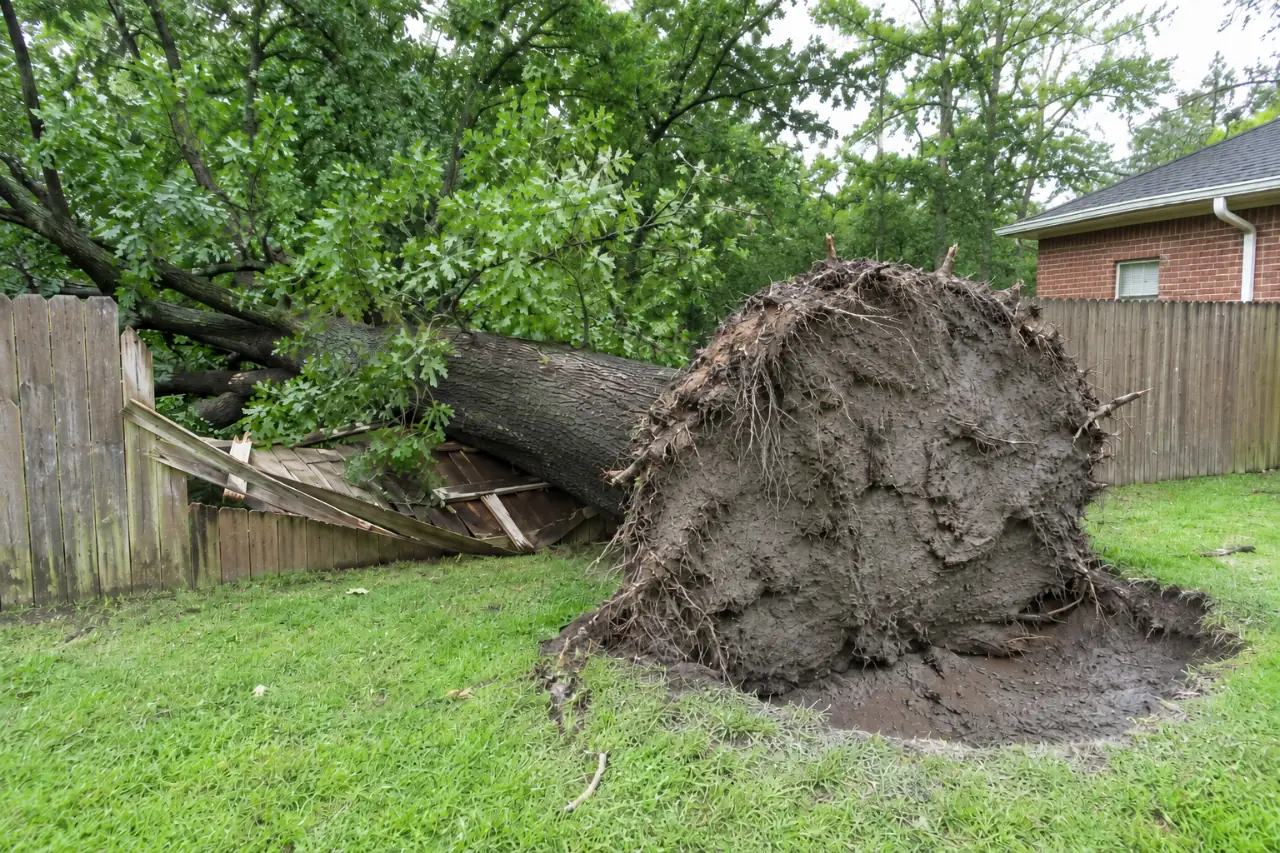
Which storms have brought trees down in and near Pike Road?
| Date | What it was | What it did to trees and homes |
|---|---|---|
| Jan. 25, 2026 | Straight-line winds, 60 to 70 mph, from near I-65 and Fairview Ave. east to near Taylor Road | Many trees and large limbs fell on houses, vehicles and roads; "Many residences suffered minor to significant damage from fallen trees and tree limbs." Lines down across I-85 closed it for a time. (NWS) |
| Feb. 16, 2025 | Barganier Road EF-1, 110 mph, 7.52 miles, starting just east of the Macon-Montgomery county line, 4 miles north-northeast of Cecil | Hardwoods snapped and uprooted near County Road 2; "Several homes and outbuildings suffered roof damage." The same event brought a 70 mph gust at Montgomery Regional Airport. (NWS survey) |
| Dec. 29, 2024 | Mt. Zion Road EF-1, 100 mph, 10.01 miles, 500 yards wide; Cecil EF-0, 80 mph, 2.5 miles | A pine fell into the corner of a double-wide mobile home; near Cecil, trees snapped and uprooted and a garage lost part of its roof cover. (NWS survey) |
| Nov. 30, 2022 | Flatwood-Willow Springs EF-2, 120 mph, 9.92 miles, Montgomery and Elmore counties | "Unfortunately an uprooted tree fell on a manufactured home, resulting in two fatalities and one serious injury." (NWS) |
| April 5, 2022 | Old US 231 EF-1, 100 mph, 7.62 miles, 550 yards wide, from extreme southeast Montgomery County into Pike County | Trees uprooted along Highway 231; so many trees snapped at one home on Old Highway 231 that the driveway was blocked. (NWS) |
| Feb. 7, 2017 | EF-0, 70 mph, 2.6 miles south of Pike Road | "Uprooted and snapped several hard and softwood trees," mostly on pasture land; a garden shed heavily damaged. (NWS) |
| April 6, 2016 | Pinedale EF-0, 80 mph, 6.01 miles, 250 yards wide, ending north of Meriwether Road | Large trees snapped or uprooted at the Pike Road Village mobile home park, some onto homes, damaging or destroying them; a Bean Road mobile home lost its roof. (NWS) |
| July 6, 2005 | F0 during Tropical Storm Cindy, 7.6 miles from south-southwest of Cecil to north of I-85 near Waugh | Several trees snapped or blown down, a baseball complex and a few roofs damaged. (NWS) |
| Sept. 16, 2004 | Hurricane Ivan, inland as it weakened | Gusts of 58 mph at Montgomery's Dannelly Field and 67 mph at Maxwell Air Force Base, with 5.32 inches of rain in Montgomery; across central Alabama, "Tree and power line damage was extensive." (NWS) |
Ivan's reach went well past Montgomery County. The Weather Service office's own write-up says that at one point "there were approximately 1.3 million customers without power in Alabama after Ivan had struck" (NWS Birmingham).
Can a storm-damaged tree be saved?
Alabama Extension's post-storm guide gives fairly firm lines (Alabama Extension, checked Nov 22, 2026):
- Leaning with the soil heaved up on the side opposite the lean: "Leaning trees with mounding indicates broken and damaged roots," and it recommends removal. "If the mounded soil has cracks in it, consider the tree a serious problem."
- Cracked trunk: "All cracks are a major problem and require immediate attention." Most such trees need removal.
- Broken trunk: "Broken off trunks require that the tree be removed." A pine trunk broken anywhere should come down.
- Hardwood broken in the top third: prune and watch it, with a moderate chance of survival.
- Big split limbs: split or broken limbs larger than 30 percent of the stem's diameter call for removal and replanting.
- Bark stripped: 50 percent or more points to removal.
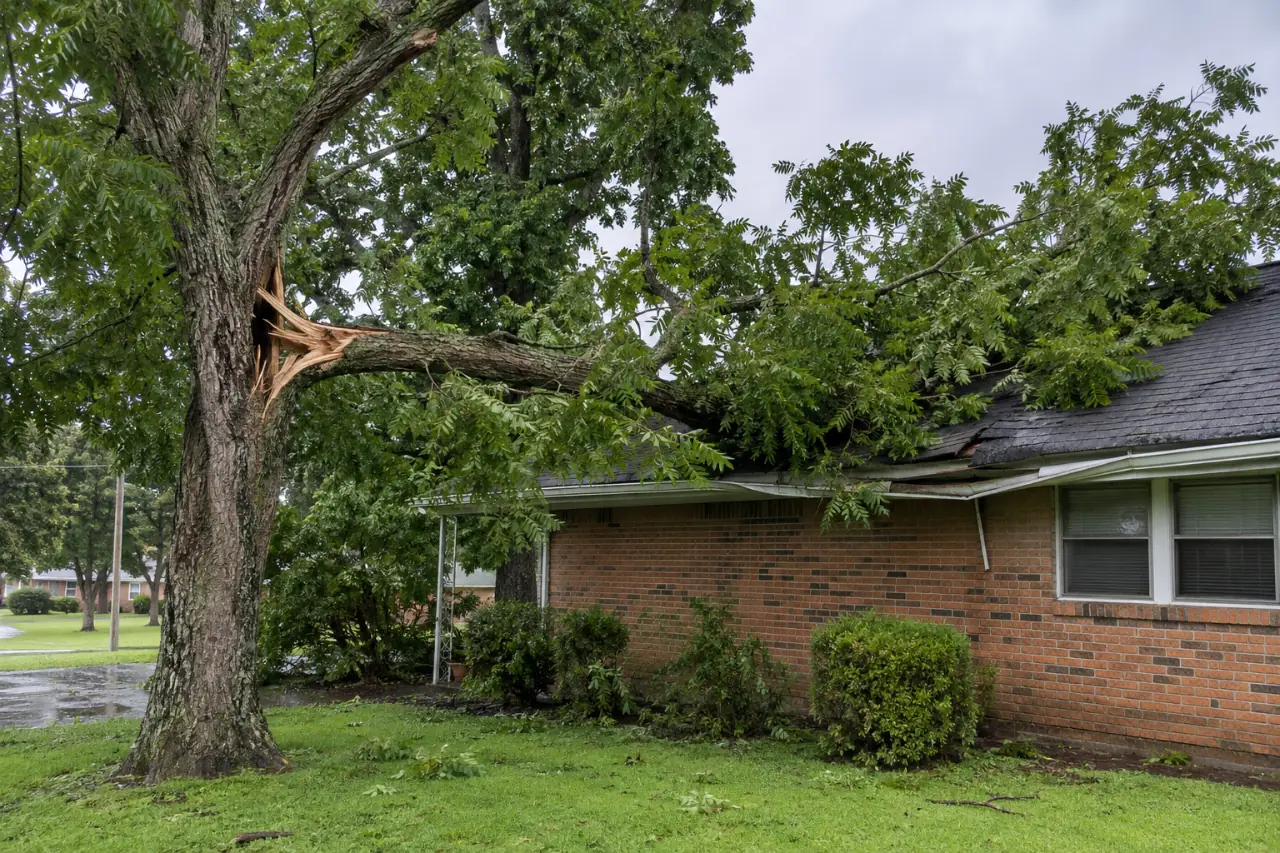
How does a crew take a tree off a house?
Slowly and from the top down. A tree lying on a roof is loaded like a spring: limbs pinned against the shingles, the trunk bent over the ridge, sometimes still attached to a lifted root plate. Cutting the wrong piece first can drop weight through the roof or swing the trunk. Crews usually tie off and lift sections with ropes from a nearby tree, a bucket truck or a crane, working from the outer limbs toward the trunk, and leave the roof decking for the roofer.
If you've filed a claim, ask the contractor for an itemized invoice that separates removing the tree from the house from hauling and stump work. Separate lines make the claim easier to sort out.
Who hauls the storm wood?
Not the power company. Alabama Power says that after severe weather it cuts trees and brush so poles and lines can be replaced, but "Disposal of any wood, limbs or debris resulting from this type of emergency operation" is the responsibility of the property owner (Alabama Power, checked Nov 22, 2026). Pike Road's yard waste pickup is run by AmWaste (Town of Pike Road utility services, checked Nov 22, 2026); after a big storm, watch for Town and County notices about extra debris collection before paying to haul curb piles.
Do Town rules slow down emergency work?
No. Pike Road's erosion ordinance, which otherwise calls for a permit before uncovering more than 500 square feet of ground, exempts "Any emergency activity that is immediately necessary for the protection of life, property, or natural resources" (Design and Construction Standards, Appendix 1, Sec. V.B, checked Nov 22, 2026). The Town's tree protection section applies to subdivisions and commercial development, not storm cleanup on a house lot. See the tree rules page.
What can be done before the next storm?
Alabama Extension's pre-storm checklist points at the trees most likely to fail: damaged or decaying root crowns, decay or cavities in the middle of the trunk, dead branches over an inch thick, long thin limbs and tight V-shaped forks (Alabama Extension, checked Nov 22, 2026). Pruning the deadwood or taking down a decayed tree on a calm day costs less and goes faster than the same job with a roof under it. See pruning and removal.
Storm questions people ask
The neighbor's tree fell on my house. Whose problem is it?
Start with your own homeowner's policy; your insurer decides how the claim is handled and whether it goes after anyone else. Photograph where the tree stood and where it landed.
Can anything be done at night?
Cutting a tree off a roof in the dark is dangerous. A tarp and a call at first light is often the better plan unless the tree is still moving or blocking an exit.
A line is down across my drive. Can the tree crew move it?
No. Only the utility handles a downed line. Keep everyone and every pet away, and call Alabama Power or Dixie Electric.