
Pike Road tree problems
Yard Trees and Clay Soils Around Pike Road, Alabama
Alabama Extension's soils guide for the Montgomery area describes two kinds of ground: sandy and loamy Coastal Plain uplands, and clayey Black Belt prairie soils that "swell when wet and shrink when dry, resulting in large cracks forming during dry spells" (Soil Descriptions and Plant Selections for the Montgomery/Prattville/Wetumpka Area, ANR-0966, checked Nov 22, 2026). Which soil a tree grows in shapes how it roots, how it holds in wind and which trees do well, and a few common yard trees, Callery pear and water and laurel oaks among them, come with problems Extension spells out.
What are the soils in the Montgomery area like?
ANR-0966, written by Charles Mitchell, Donn Rodekohr and Shane Harris of Alabama Extension for the Montgomery, Prattville and Wetumpka area, sorts them into five groups:
| Group | What it is | Trees Extension names for it |
|---|---|---|
| Clayey, alkaline | pH above 7.0; "a shallow olive gray, clayey topsoil overlying Selma Chalk"; slow to take in water; swells and cracks | Eastern red cedar, live oak, white oak, ash, hackberry, crabapple, redbud, crape myrtle |
| Clayey, acid | pH below 7.0; "Several feet of acid, clayey soil may overlie alkaline Selma Chalk"; slow permeability; may swell and crack | "Pine trees will grow on the better drained sites," but "white oaks, red oaks, pecans, and other deciduous trees make better landscape trees" |
| Loamy, well drained | Naturally acid Coastal Plain soils; "A reddish orange subsoil color is one indication of a well-drained soil" | See the plant lists in ANR-0966 |
| Poorly drained | Mostly level, sandy to clayey, and "remain saturated for most of the year" | See the plant lists in ANR-0966 |
| Mixed acid and alkaline | Areas where soils of the first three groups are mixed together | None named for this group |
Alabama Extension's statewide soils publication describes the Black Belt as named for "the dark surface colors of many of the soils," formed from "alkaline, Selma chalk or acid marine clays," with "Acid and alkaline soils" intermingled throughout and clays that "shrink and crack when dry and swell when wet" (Soils of Alabama, ANR-0340, checked Nov 22, 2026). That mix is why two yards on the same road can behave differently.
What do Black Belt clays look like below the surface?
Two of the region's widespread soil series show the range, from the USDA's official series descriptions:
- Sumter: grayish brown silty clay at the surface over light yellowish brown silty clay, with chalk 20 to 40 inches down. Well drained but slowly permeable. Where it's wooded, on steeper ground, the native trees are oaks and red cedar (USDA, Sumter series, checked Nov 22, 2026).
- Oktibbeha: "very deep, moderately well drained, very slowly permeable soils that formed in clayey sediments" over chalk or calcareous clays, with a yellowish red clay subsoil. Mostly woodland, where the common trees are "loblolly pine, shortleaf pine, southern red oak, post oak, sweetgum, and hickory" (USDA, Oktibbeha series, checked Nov 22, 2026).
Both occur in the Blackland Prairie of Alabama and Mississippi. Which series lies under a given Pike Road lot takes a soil map or a shovel to answer.
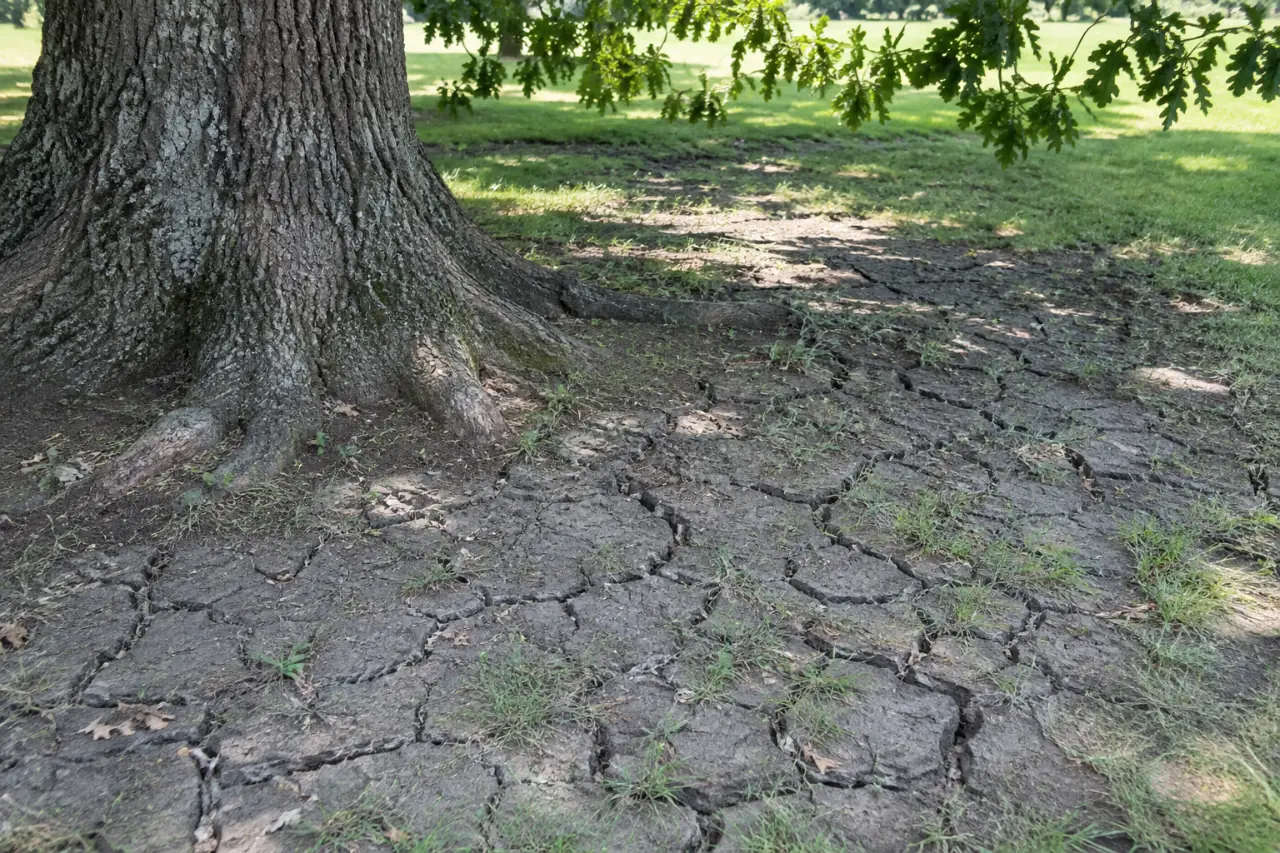
What does shrink-swell clay mean for a tree?
Clay that cracks in a drought and swells back after rain is slow to drain in between. Extension describes these soils as having "moderately slow to slow infiltration and permeability," and notes they cause problems for septic field lines "because they perk very slowly" (ANR-0966, checked Nov 22, 2026). For tree work that adds up to:
- Soft ground after rain. Bucket trucks, grinders and loaders rut wet clay. A dry stretch is easier on the lawn.
- Watch a tree that starts to lean. Extension's post-storm guide says "Leaning trees with mounding indicates broken and damaged roots," and to treat cracks in that mounded soil as a serious problem (Alabama Extension, checked Nov 22, 2026).
- Know where the septic field runs. Heavy equipment over field lines in slow-draining clay is a problem nobody wants. Show the crew where the tank and lines are.
Why do Callery and Bradford pears break?
Alabama Extension says the Bradford cultivar of Callery pear "was found to be structurally weak due to its branching pattern," and that the species has proven "very successful at invading disturbed areas, open fields," pastures, rights-of-way and forest edges (Callery Pear: History, Identification, and Control, FOR-2078, checked Nov 22, 2026). You can spot it by its white flowers from February to April, which have an "unpleasant scent," and on most trees growing wild by their sharp, thorny spur shoots.
For a large pear in the yard, Extension recommends removal followed by stump grinding, with the lateral roots taken out too, "otherwise they will continue to sprout." Without grinding, "cut stump herbicide treatment is essential." A pear with a split already running down from a fork is a candidate for removal before the next storm. See stump grinding.
What about water oaks and laurel oaks?
Extension's post-storm guide notes that water and laurel oaks may not respond well to pruning, so when a large branch on one cracks, taking down the whole tree may be worth considering (Alabama Extension, checked Nov 22, 2026). White oaks and live oaks, by contrast, are on Extension's list of trees suited to the area's alkaline clays, and white and red oaks to its acid clays (ANR-0966).
Signs that any big oak deserves a closer look, from Extension's pre-storm checklist: damage or decay at the root crown, cavities or decay in the middle of the trunk, dead branches more than an inch thick, long thin limbs, and tight V-shaped forks (Alabama Extension, checked Nov 22, 2026).
And pines?
Loblolly and shortleaf pine are common woodland trees on Black Belt clays like Oktibbeha, and ANR-0966 says pines grow on the better-drained acid clay sites. Their biggest threat in a yard is bark beetles after drought, storm damage or construction. The pine page covers the signs and what to do.
What about old pecans?
ANR-0966 lists pecans among the better landscape trees for the area's acid clays. Old pecans get big: HomeGuide's national range for removing one is $650 to $2,700, and pecans over 60 feet fall in its top trimming tier, $1,000–$2,500-plus (HomeGuide removal; HomeGuide trimming; both checked Nov 22, 2026). Deadwood over a roof or a drive is the usual reason to call.
What should go in after a removal?
- Match the tree to the soil group in the table above.
- Keep it out of utility easements, as Pike Road's landscape standards ask (Sec. 702.03(I)(1), checked Nov 22, 2026), and well away from overhead lines.
- Call 811 before digging the planting hole.
- Skip Callery pear. Extension's publication on it is about getting rid of it.